It hits you like a virtual sledgehammer. An email appears with a subject line that makes your stomach turn: "URGENT: Legal Payment Required" or "LEGAL: Immediate Cessation Required." Your attention immediately shifts from business planning and growth strategies to an alarming monetary demand. A claim seeking $50,000, $100,000, or higher amounts for a claimed intellectual property infringement or an old, forgotten debt. Your first impulse is to contact an attorney, but that thought quickly leads to a second wave of anxiety when you hear the retainer fee: $10,000, $15,000, or up to $25,000 for initial representation. Many entrepreneurs face this devastating choice-a choice between a devastating financial agreement and a financially crippling legal battle.
Consider a third possibility? What if you could respond strategically without breaking the bank? For an increasing amount of entrepreneurs, this alternative approach is now possible through AI legal defense. This isn't about replacing lawyers entirely, but about shifting the traditional approach. It's about utilizing innovative solutions to assess risks, develop strategies, and know your legal position before investing in expensive legal services. This demonstrates how business owners are regaining control on legal bullies, cutting down on substantial legal costs, and discovering the strength to protect their enterprises in an environment of growing legal challenges.
Critical Takeaways
- The Power Dynamic is Shifting: AI tools are making it possible entrepreneurs to manage various legal challenges themselves, reducing reliance on expensive legal counsel for early defense phases.
- Education is Your Best Defense: Most legal threats targeting small businesses are designed to intimidate and typically rest on weak legal foundations. Familiarity with copyright law basics and debt validation requirements becomes your most effective protection.
- AI as a Research Assistant: Artificial intelligence can analyze legal documents, identify weaknesses in claims, and discover pertinent case law in a fraction of the time it would take a human, reducing your legal costs substantially.
- Financial Considerations are Key: Traditional legal retainers beginning at $10,000-$25,000, AI-driven legal resources deliver a cost-effective first line of defense at considerably reduced rates.
- Understanding When to Seek Professional Assistance: Artificial intelligence is a helpful aid in preparation and early action, but it is not meant to be a replacement for a qualified lawyer when dealing with legal proceedings or intricate legal issues.
Essential Legal Considerations for Small Business Operations
Being a small business owner means wearing multiple hats. You're simultaneously the CEO, marketing director, HR manager, and sometimes even the custodian. Dealing with lawsuits is the last thing you want while running your operations. Regrettably, contemporary business operations face numerous legal challenges. Research from 2023 reveals that American small enterprises suffer $160 billion per year from legal disputes. We're not talking about just big-ticket litigation; they're the everyday legal challenges that steadily consume business funds.
The Emergence of the Litigation Bully
Numerous legal threats have little to do with justice; they are fundamentally a numbers game. Predatory firms, copyright trolls, and aggressive collectors send out massive amounts of threatening correspondence, understanding that a certain percentage of targets will be too fearful or unaware to stand up for their rights. They count on the fact that legal representation expenses usually cost more than the demanded settlement amount. This generates a perverse incentive to pay, regardless of whether the case is valid. These operations serve as legal bullies, employing intimidation as their primary tactic.
Key Risks Entrepreneurs Must Navigate
Even though legal challenges can arise from various sources, certain recurring challenges consistently plague small enterprises:
- Copyright Infringement Claims: These issues are frequently related to visual content used on corporate web pages and blogs. Many of these claims are generated automatically and issued without proper manual verification of fair use or contextual factors.
- Debt Collection Notices: You might receive notices about expired, disputed, or questionable debts. Debt collectors usually buy debts at a fraction of their value and then use aggressive tactics to recover the entire balance.
- Cease and Desist Letters: These legal documents can address a broad spectrum of matters, ranging from trademark infringement to contract disagreements. They are commonly employed to deter competition or silence opposition.
- Banking and Payment Disputes: Disagreements involving financial institutions or payment services can suspend financial access and operations, leaving entrepreneurs to defend their interests.
When business owners are confronted with these challenges, it often seems like a full-blown crisis. The reality, however, is that a majority of these situations are essentially matters of education and preparedness, not litigation problems.
Understanding Legal Defense Costs: Traditional Methods Falling Short for Small Businesses
The traditional approach for handling a legal challenge is simple: you retain an attorney. For major businesses with corporate legal staff and deep pockets, this is a standard expense of doing business. For a small company, it's a significant financial strain. The average legal spend for a small company is about $13,300 each year, but this number can increase dramatically when court proceedings begin, with fees ranging from $3,000 to over $150,000.
The Retainer Trap
The primary upfront challenge is the attorney retainer. A retainer is basically an initial deposit on a lawyer's services, and for litigation cases, it's seldom less than five figures. This leads to what can be termed the "retainer trap." An entrepreneur could get a request for $8,000. An attorney estimates a $15,000 retainer to contest the claim. Financially speaking, the "logical" decision seems to be paying the $8,000 payment, even if the allegations are unfounded. This is the business model that aggressive plaintiffs depend on. They've carefully calculated their demands to be right beneath the threshold cost for legal representation.
Incentive Misalignment
Additionally, the traditional legal system is structured on billable hours. When a case takes more time, the lawyer earns more money. While ethical lawyers aim for efficiency, the framework naturally incentivizes extended litigation and complex procedures. This poses a clear contradiction with the needs of small business owners, who need solutions that are quick, efficient, and cost-effective. The main goal for the business owner is to address the situation, not to become involved in a prolonged and expensive legal process.
How AI is Revolutionizing Legal Advocacy for Business Executives
For decades, the steep pricing of legal assistance produced an enormous disparity in the market. No practical solution existed for entrepreneurs who couldn't afford legal counsel but wouldn't yield to unfounded allegations. Artificial intelligence is currently bridging that gap. It's not a perfect answer, but it is a powerful tool that creates equal opportunities by significantly decreasing the expenses and duration associated with the initial, most critical stages of a legal defense.
AI: The Next-Generation Paralegal
Think of AI similar to a paralegal possessing a photographic memory and the ability to process enormous volumes of documents per minute. Let's explore its applications:
- Document Analysis: AI systems can thoroughly review legal documents and complaints and instantly identify essential elements, including specific allegations, applicable regulations, and demanded compensation amounts. The AI evaluates the document to extensive case databases to highlight vulnerabilities and recurring themes.
- Legal Research: Rather than a lawyer spending hours (at $300+ per hour) examining legal cases, AI technology can search legal databases and provide relevant precedents instantly. The AI can identify data on debt validation requirements, fair use provisions, or specific consumer protection statutes pertaining to a case.
- Drafting Assistance: AI can help with creating preliminary correspondence. After inputting the claim details and pertinent legal guidelines, it can create a polished, well-structured document that establishes your position and puts the opposing party on notice that you will defend your position firmly.
Here's where everything shifts. The first evaluation and examination, which traditionally costs thousands in legal fees, can be handled with a fraction of the cost in an AI-powered educational platform.
Understanding the AI Legal Defense Framework: A Systematic Approach
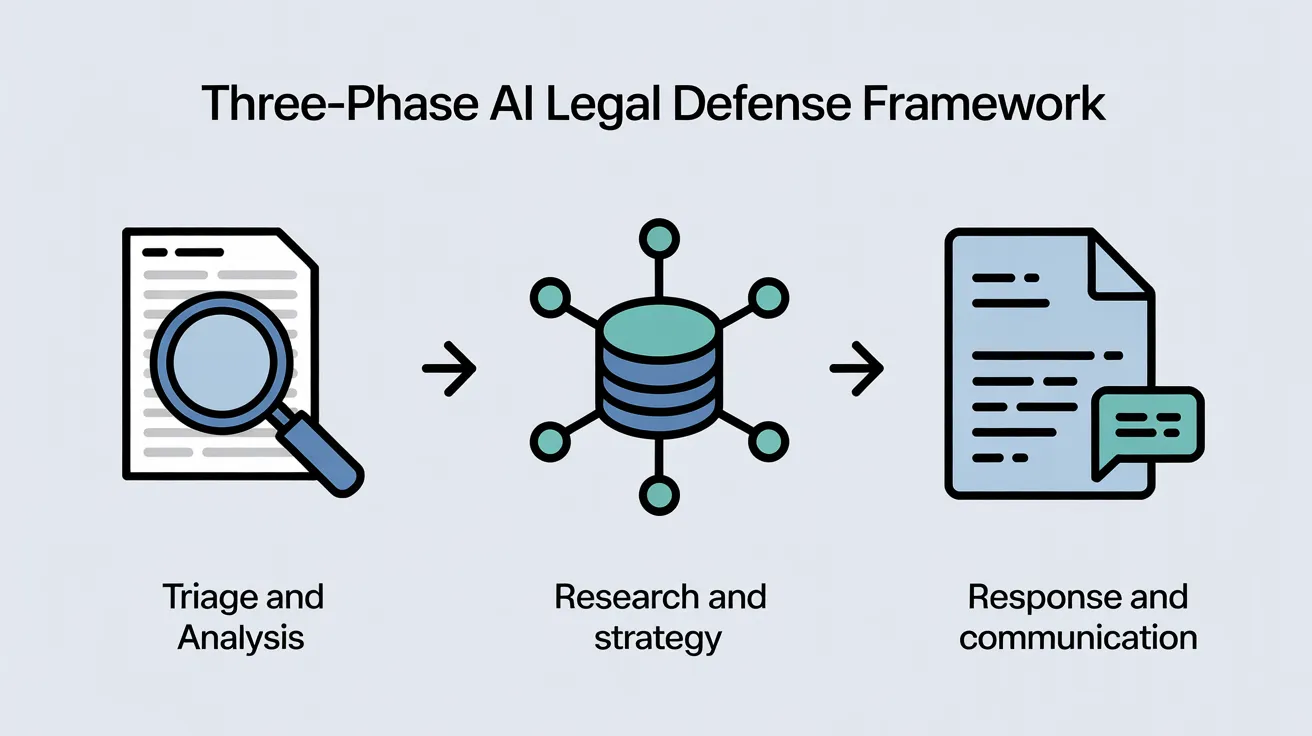
Implementing AI for legal defense goes beyond mindlessly following a chatbot. It's about implementing a systematic framework to analyze the challenge, comprehend your position, and reply from a place of strength. This approach typically encompasses three critical phases.
Phase 1: Initial Review and Analysis
To begin is to employ AI technology to analyze exactly what you're facing. You can feed the threatening legal document into an AI tool and request an preliminary review. The objective is to answer several key questions:
- What is the key complaint
- What specific laws or regulations are being referenced?
- Can we verify if the claimant is the actual rights owner?
- What evidence have they presented?
- Are there any immediate red flags or warning signs in what they're claiming?
This initial assessment enables you to progress from a state of panic to having clear understanding. It provides an objective overview of the circumstances.
Phase 2: Research and Strategy
Once you comprehend the claim, the next phase is to leverage AI to explore your defensive possibilities. For a copyright claim, you could prompt the AI to research the four factors of fair use and how they apply to your individual situation. For a debt collection notice, you must direct it to explain the validation requirements under the Fair Debt Collection Practices Act (FDCPA). This step is focused on developing your case. You are gathering the legal principles and facts that will form the foundation of your response. This is also where you can begin to pinpoint the vulnerabilities in your opposition's position.
Stage 3: Response Protocol
Now that your research is complete, you can utilize AI to assist in drafting a response. This isn't meant for sending a computer-generated response. Rather, it focuses on leveraging AI as a writing tool. You input the key arguments and factual background, and AI helps structure these elements into a professional and coherent letter. Your response should typically:
- Acknowledge the receipt of their communication.
- Articulate your viewpoint with clarity and brevity.
- Include the specific legal tenets that back up your viewpoint.
- Request further documentation and confirmation, as appropriate.
- Stay objective and focus on facts.
This organized reply proves to the opposing side that you are well-prepared, knowledgeable, and organized to defend your position. It instantly transforms the situation from one of coercion to one of a serious legal conversation.
Managing Copyright Claims Through AI Analysis and Response
Intellectual property disputes stand as one of the most common threats for digital enterprises. Organizations may incorporate a photograph on their website, before encountering a hefty financial demand from a stock photo company in the future. AI technology shows remarkable efficiency for such cases.
Analyzing the Claim
Artificial intelligence software can assist in examining the claim. It examines the legal notice to verify if it provides evidence of copyright ownership, an official registration number, and a clear explanation of the claimed violation. A lot of claim letters from predatory copyright claimants are intentionally vague and are missing these crucial details. As business leader Tony copyright of LinkDaddy learned, automated tools can be employed to assess the legitimacy of a demand, resulting in a successful challenge against a $500,000 copyright demand without engaging a lawyer.
Researching Fair Use Guidelines
AI can be an effective resource for investigating the doctrine of fair use. Fair use represents a legal concept that permits controlled utilization of copyrighted material without permission from the rights holder. An AI can help you comprehend the four factors of fair use and how they might apply to your case, delivering you with the arguments you need to build a strong defense.
Debt Collection Defense: AI-Powered Validation Strategies
Another area where AI is creating meaningful change centers on safeguarding against intimidating collection agents. The Fair Debt Collection Practices Act grants business owners and consumers particular legal rights, notably the ability to demand proof of debt.
The Importance and Strength of Validation Documentation
A collection agency must give you with documentation about the debt, called validation details. When you send a debt validation letter, you are officially asking that the collector prove that you owe the debt and that they have the legitimate claim to collect it. Numerous collection agencies, particularly those who buy old debt, fail to produce this documentation. AI technology can support you with creating a complete debt validation letter that requests all the necessary information, such as:
- The original creditor's name
- The initial account number
- An authentic copy of the initial contract with signatures.
- A full accounting of the purported debt.
Delivering a well-written validation letter typically halts a debt collector from continuing. If they cannot validate the debt, they cannot legally continue to try to collect it.
When AI Legal Defense Works (And When It Doesn't)
It is crucial to be aware of the limitations of AI in the legal industry. AI functions as a learning and preparation resource, not a certified legal practitioner. Knowing the difference between what you can address personally and when you need an attorney is vital for a solid defense strategy.
Optimal Cases for AI Defense Implementation
- Preliminary Risk Evaluation: Reviewing legal demands and cease and desist documentation.
- Responding to Baseless Claims: Developing strategies against copyright trolls and debt collectors who depend on threatening behavior.
- Legal Research: Understanding the legal rights and the legal principles relevant to your situation.
- Organizing Your Case: Preparing all your materials and arguments prior to meeting with a legal professional, which can help you save thousands of dollars in billable hours.
When to Contact a Lawyer Right Away
There are certain situations where you should avoid representing yourself. If you've been served legal papers, you must hire a lawyer. Other scenarios that require professional legal help include:
- Criminal allegations.
- Official regulatory investigations by government authorities.
- Complicated legal cases that involve multiple parties or jurisdictions.
- High-stakes scenarios where the possible losses could ruin your business.
In these situations, the purpose of AI shifts from a main protective tool to a support system. You can utilize it to become more knowledgeable and equipped as a client, but you need a human expert on your side.
Building Your AI Law Protection Toolkit
Getting started with AI legal defense isn't dependent on a degree in computer science. It essentially needs a willingness to learn and connection to the proper tools. The foundation of your toolkit will be a powerful language model like ChatGPT or Claude, alongside an educational platform that provides specialized prompts and frameworks for typical legal threats.
The Critical Role of Effective Prompts
The performance of any artificial intelligence tool is determined by the quality of the prompts you provide. A generic prompt like "write a response to this demand letter" will generate a general and possibly unsuitable result. Conversely, a specialized prompt will instruct the AI to carry out a thorough analysis and create a response founded on specific legal principles. This is the reason platforms that offer battle-tested prompts and frameworks are so important.
Small Business Victory Stories: Fighting Back and Winning
The noteworthy example of Tony copyright, who successfully saved his business in excess of $511,000 by using AI to combat three major legal threats, serves as a striking illustration of what is achievable. Yet he is not alone. Throughout the country, small business owners are discovering that they possess more power than they imagined. They are leveraging AI to challenge baseless copyright claims and compel debt collectors to validate their debts. These successes are not merely about saving money; they are about reclaiming a sense of control and declining to be victims of a system that has historically been weighted against them.
Legal Defense: The Path Forward for Small Business Owners
The adoption of AI into the legal industry is just beginning to emerge, but the direction is evident. Access to legal assistance is becoming more accessible and affordable. The conventional guardians of the legal profession are facing disruption by digital tools that assist private citizens and companies. This doesn't suggest that lawyers will disappear. It means that their role will transform. They will have the opportunity to focus on the high-level, complex work that truly requires their expertise, while AI manages the more standard and preparatory activities.
Small business proprietors, this marks an encouraging shift. This indicates that moving forward, a legal challenge may no longer be a cause for financial anxiety, but rather an issue to be addressed efficiently and thoughtfully.
Making Your First Move: Your First Steps with AI Legal Protection
As a small business owner, you need to begin exploring AI legal defense at this moment, before you need it. Learn about available tools and platforms. Understand the essential aspects of legal protection and financial recovery. By taking these proactive steps, you can build a shield around your business. You can change your position from an exposed entity into a well-equipped protector of your company's accomplishments.
FAQs
Is AI genuinely useful for legal defense, or is it merely empty promises?
Artificial intelligence serves as a valuable resource for legal defense, but it's crucial to understand its role. It doesn't take the place of an attorney. Instead, think of it as an exceptionally capable aid for research and document preparation. It can help you examine case materials, comprehend difficult legal concepts, and draft initial responses, all of which results in saving substantial resources. The key is to use it for the initial stages of a defense and to understand when to consult a human expert.
When should I use AI tools versus hiring a lawyer?
Leverage AI tools to perform the first analysis of legal challenges, when crafting responses to what appear to be baseless claims (like those submitted by copyright trolls), and for organizing your legal case. It's essential to hire a lawyer immediately if you have been served with a lawsuit, encounter criminal charges, or are managing a complex legal issue that could significantly impact your business. A practical approach is: utilize AI for preliminary work, but work with a lawyer when litigating.
How cost-effective is AI for legal defense?
You can achieve significant cost savings. The initial legal review and demand letter response can cost thousands in lawyer fees. By leveraging AI technology, you can complete this work at a substantially reduced cost. Early resolution through AI intervention can result in tens of thousands in savings. Should you require an attorney later, prior AI assistance can help decrease their billable hours.
What are the key limitations of AI in legal contexts?
There are multiple key limitations to AI. It lacks legal standing and cannot serve as legal representation. It cannot match the nuanced understanding of a practiced legal professional and might not comprehend the intricacies of individual legal situations. Additionally, it functions based on its training data, which could be outdated. Most importantly, get more info AI can only offer information and assistance, not legal advice.
Is it legal using AI to perform document analysis in legal contexts?
It is absolutely legal to utilize AI for document analysis and comprehension. This is merely using technology as a research and preparation tool, comparable to using common digital tools like search engines and word processors. The critical legal boundary is that you cannot claim to be a legal professional without proper credentials, and artificial intelligence cannot function as your legal representative.
6. How can I distinguish if a legal threat is genuine or merely pressure?
This is an area where AI analysis proves to be particularly useful. A genuine legal notice typically will usually be specific, provide proof of the allegations (such as a copyright registration number), and be sent by a legitimate law firm. A scare attempt, however, is often unclear, doesn't include evidence, and frequently includes aggressive or unprofessional language meant to force a hasty payment. AI can help you spot these danger signals.
The Fair Debt Collection Practices Act (FDCPA): What protections does it offer?
The FDCPA is a federal statute which limits the actions of third-party debt collectors. You are safeguarded against abusive, unfair, or deceptive practices. Among its strongest features is your ability to demand proof of the debt. If a collector cannot prove your responsibility for the debt and their legal right to collect, they are required to cease collection activities. This provides essential protection for small business owners who might face questionable or outdated debts.